
9 de agosto de 2022|programatica
What is Programmatic Advertising?
Programmatic advertising is the automated process of buying and selling digital ad space using technology and data instead of manual negotiations. Every ad impression is evaluated in real time, allowing advertisers to decide instantly whether it’s worth bidding on a specific user in a specific context.
What used to be just display advertising has expanded into a much broader ecosystem. Today, programmatic includes formats like connected TV (CTV), mobile apps, digital audio, native placements, and even digital billboards.
At this point, programmatic isn’t some advanced tactic. It’s the default infrastructure behind most digital advertising. Ignoring it now is like trying to rank a site without understanding how Google works. Technically possible. Practically painful.
How Programmatic Advertising Works
The entire process happens in fractions of a second, faster than a user can blink.
When someone lands on a website or opens an app, that page sends a signal saying an ad space is available. That opportunity is immediately evaluated across multiple platforms, where advertisers decide if that specific user matches their targeting criteria.
If it does, they place a bid. The highest bidder wins, and their ad appears almost instantly.
This system is commonly referred to as Real-Time Bidding (RTB), although today it’s just one part of a broader set of buying methods.
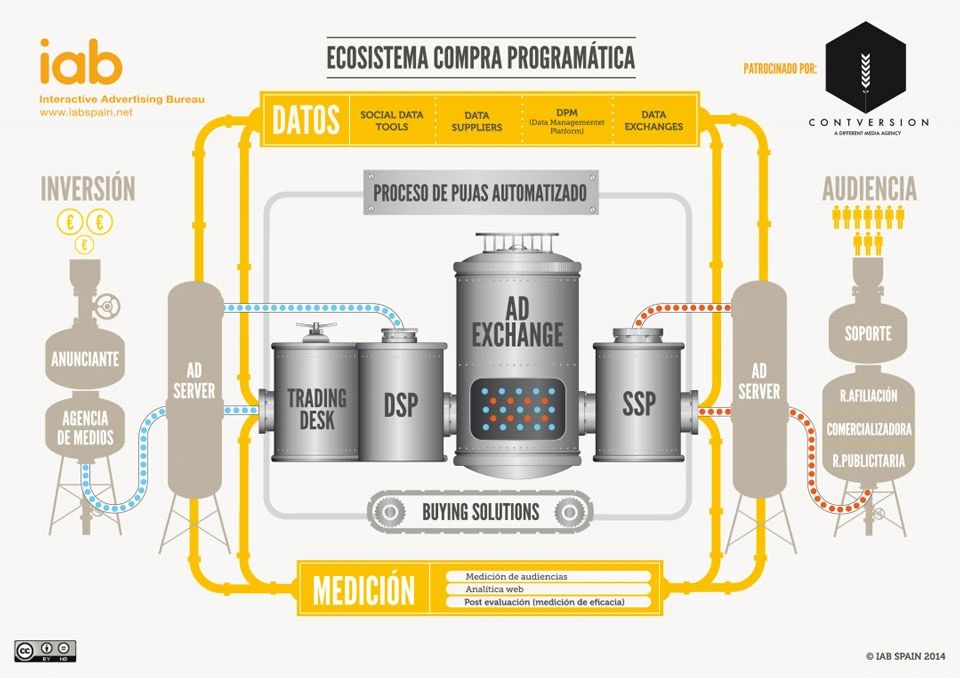
Main Elements of Programmatic Advertising
Here’s the ecosystem broken down without the usual industry nonsense.
Demand-Side Platform (DSP)
A DSP is the tool advertisers use to buy ad inventory.
Inside a DSP, advertisers define who they want to reach, how much they’re willing to pay, and what goals they’re optimizing for. The platform then evaluates millions of opportunities and makes bidding decisions automatically.
It’s essentially the command center for campaign execution. Without it, you’d be manually negotiating placements like it’s 2008.
Supply-Side Platform (SSP)
On the other side, publishers use SSPs to manage and sell their available ad space.
An SSP connects a publisher’s inventory to multiple buyers at once, increasing competition for each impression. It also allows publishers to control pricing and decide which advertisers can access their inventory.
If DSPs are built to spend money efficiently, SSPs are built to extract as much value as possible from every impression.
Ad Exchanges
Ad exchanges are the digital marketplaces where buyers and sellers meet.
They facilitate the auction process, matching demand from advertisers with available inventory from publishers. Everything happens automatically, with thousands of transactions occurring every second.
They’re basically the stock market of advertising, except instead of trading companies, you’re trading attention.
Data Management Platforms (DMP)
A DMP is used to collect and organize audience data from different sources.
This data is then used to create audience segments based on behavior, interests, or demographics. These segments can be activated inside a DSP to improve targeting.
In simple terms, the DMP helps define who matters, so campaigns aren’t just spraying ads at random people and hoping something sticks.
Ad Servers
Ad servers handle the delivery and tracking of ads.
They make sure the correct creative is shown, track impressions and clicks, and measure performance across different channels. There are advertiser-side ad servers and publisher-side ad servers, each serving a different role in the ecosystem.
Without ad servers, you’d have zero visibility into what’s actually happening. Which, to be fair, is still how some campaigns are run.
Data and Targeting Layer (What Actually Matters Now)
This is where things have changed the most.
Third-party cookies are fading out, and privacy regulations are forcing advertisers to rethink how they target users. As a result, the focus has shifted toward:
- First-party data (your own audience data)
- Contextual targeting (based on content, not identity)
- Privacy-safe identifiers and aggregated signals
The advantage no longer comes from having access to tools. Everyone has those. The real edge comes from having better data and knowing how to use it responsibly.
Types of Programmatic Buying
Programmatic isn’t just one method anymore. There are different ways to buy inventory depending on control and transparency.
Real-Time Bidding (RTB)
Open auctions where impressions are bought in real time and anyone can participate.
Private Marketplace (PMP)
Invitation-only auctions with selected publishers, usually offering higher-quality inventory.
Programmatic Guaranteed
Direct deals between advertiser and publisher with fixed pricing and guaranteed impressions, but executed through programmatic systems.
Preferred Deals
Agreements that give advertisers priority access to inventory before it becomes available in auctions.
These variations exist because brands realized not all impressions are created equal, and not all environments are worth the risk.
Key Benefits of Programmatic Advertising
The real advantages are pretty straightforward:
- More precise targeting
- Faster optimization based on performance data
- Ability to scale campaigns across multiple channels
- Better control over budget allocation
- Reduced manual workload
It’s not magic. It just removes inefficiency and replaces it with data-driven decisions.
The Reality of Programmatic in 2026
Programmatic has matured, and the expectations have changed with it.
What matters now:
- Owning and leveraging first-party data
- Running campaigns across multiple formats, especially CTV
- Using AI-driven optimization as a baseline, not a bonus
- Maintaining compliance with privacy regulations
- Focusing on quality inventory instead of cheap impressions
The ecosystem is more complex, but also more powerful. The gap between advertisers who understand it and those who don’t is getting wider every year.
Programmatic advertising is essentially a system that decides, in real time, where your money goes and who sees your message.
If you understand how each piece works, you can control performance and scale efficiently.
If you don’t, you’re just feeding budget into a machine and hoping for the best.
And that strategy, surprisingly, still exists.
Autor: Julio Bethelmy